We're building an API that lets your agent run physical experiments
in staged robot rooms. We're preparing the first physical pilot.
Join the waitlist to help shape it.
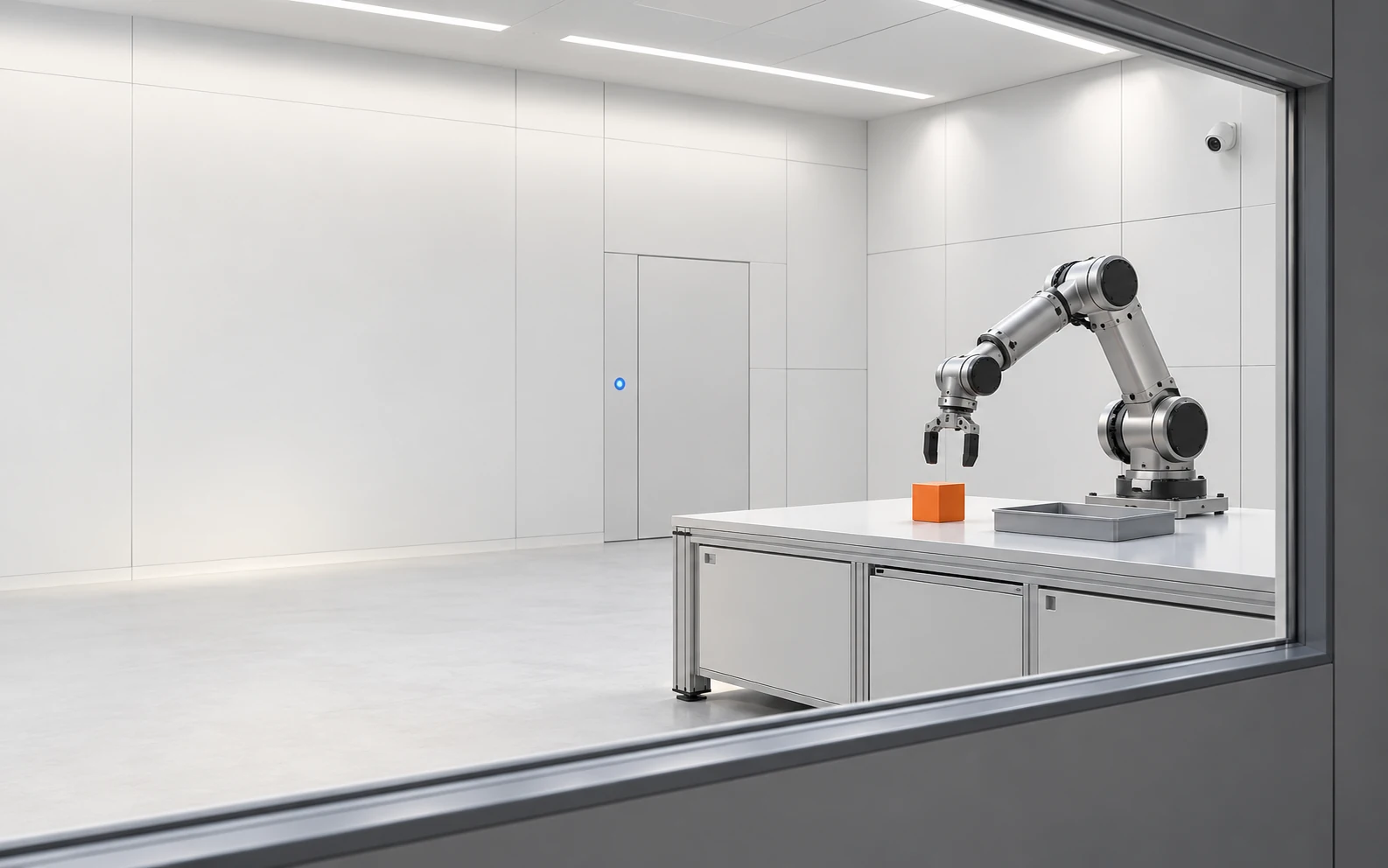
Each room is a staged environment: two grippers and laundry, an
arm with objects and bins, a humanoid in a living room. Your
agent searches them and picks the one that fits.
Illustrative inventory
02 / APPROVE A BUDGET
You set the cap.
Your agent quotes the session and asks before it spends. Approve
$10 and it cannot spend more. No signup forms, just an API key
and payment.
Room
Chamber 01 · arm, cube, tray, camera
Session
Up to 6 minutes at $80 / hour
Start state
As the last run left it. Room prep is optional (+$5)
Illustrative quote
03 / SETUP IN ABOUT A MINUTE
Ready in a minute.
The session starts, the robot homes, the cameras stream and the
agent looks at how the room was left. After that, the
experiment time is yours.
Target for ready, compatible rooms
04 / RUN THE EXPERIMENT
Your agent takes it from here.
Your agent sends each step through the SDK. Our robot adapters
run it inside the room's safety limits while the cameras record
everything.
Scroll to move the illustrated arm
Scripted illustration
05 / REVIEW THE EVIDENCE
Video and data come back.
Your agent analyzes the observations, shows you the recording
and proposes the next experiment, inside the budget you set.
We're building robot rooms that your agent can use through an API. Join the waitlist for pilot access and launch updates.
The rooms, prices and workflow on this site are concepts. Physical bookings and a hosted MCP connection are not available yet.
PLANNED AGENT WORKFLOW
LIKE RUNPOD OR FAL.AI, FOR ROBOTS
Your agent finds us. You approve the spend.
Developers ask Claude Code or Codex to build a robot. When the plan
needs real hardware, the agent reaches Actuator Science through the
tools it already uses, books a room and brings back the evidence.
01 / MCP SERVER
Rooms as tools.
Your agent lists rooms, reads their equipment and limits, quotes a
session and runs it, all from the conversation you are already
having.
02 / SDK
Code that drives the robot.
A Python SDK for controllers and policies that stream steps, read
cameras and measurements, and export the run when it ends.
03 / PLUGIN
One install for your agent.
A plugin for coding agents bundles the tools with guidance on
choosing a room, asking for a budget and analyzing what comes
back.
YOU
"Test this grasp controller on a real arm. You can spend up to
$10."
Compare the robot, props, observations and control interface. Start
with a tabletop arm, or explore the larger rooms we intend to build.
Your agent checks the exact published configuration before booking.
PLANNING CATALOGUE · All physical setups below are planned. Rates are
illustrative USD hypotheses, not live offers. The current executable
service is local software simulation.
6 planned configurations
One room-hour includes the listed robot and cameras. Alternative
layouts may share equipment; these cards do not represent six
independently available stations. Final hardware, rates and support
require admission. Room images are AI-generated concepts, not
photographs or exact hardware models.
Arm examples use US$80/hour. Other rates come from saved planning
research and remain unvalidated. The current local software-simulation
API uses a separate US$20/hour pricing preview and development credits;
this page changes no service rate. Pricing notes.
Access
An API key and payment. No sales call, no lab onboarding.
Budget
Your agent quotes first and asks you to approve a cap, such as
$10. It cannot raise the cap itself.
Setup
About a minute on a ready, compatible room. The experiment and
analysis can take as long as you book.
Start state
Rooms start as the last run left them, which keeps turnover fast.
Add room prep (for example $5) or book a longer session for a
guaranteed start.
Sessions
A few minutes to try an idea. Book 15 to 60 minutes when your
agent needs many attempts to iterate.
Results
Video, observations, run logs and a usage receipt, returned to
your agent to analyze.
Longer term, autonomous agent research teams with their own budgets
will run physical experiments here instead of building a lab.