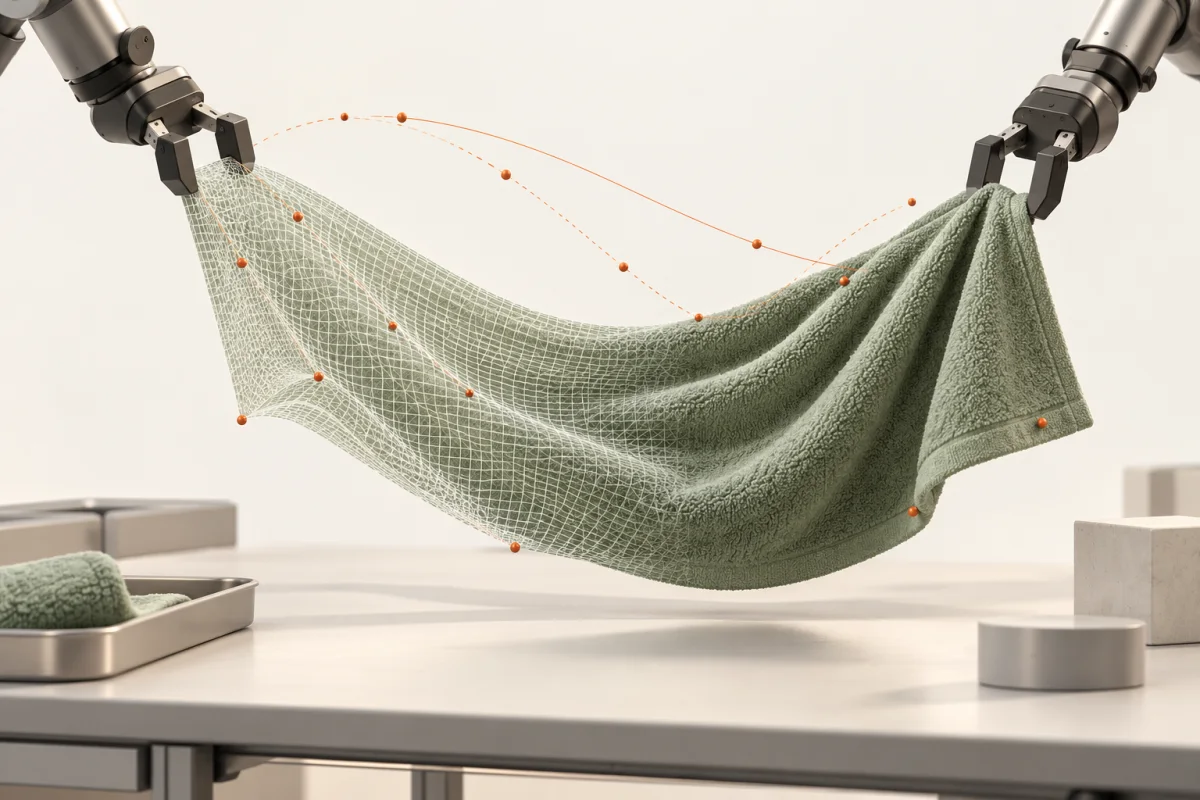
Cloth manipulation gives robotics researchers two connected questions: can simulation help train a useful policy, and how closely does the simulated fabric follow the physical fabric? Each question needs its own evidence.
SoftMimicGen makes progress on the first. It expands a small set of human demonstrations into synthetic demonstrations for deformable manipulation, then uses them to train policies. Its real-world evaluation includes towel folding, rope manipulation and bag loading. [1]
The reported real-world results
The paper compares training on 30 real demonstrations, 1,000 synthetic demonstrations, and a combination of both. Table III reports the following task-success percentages. [1]
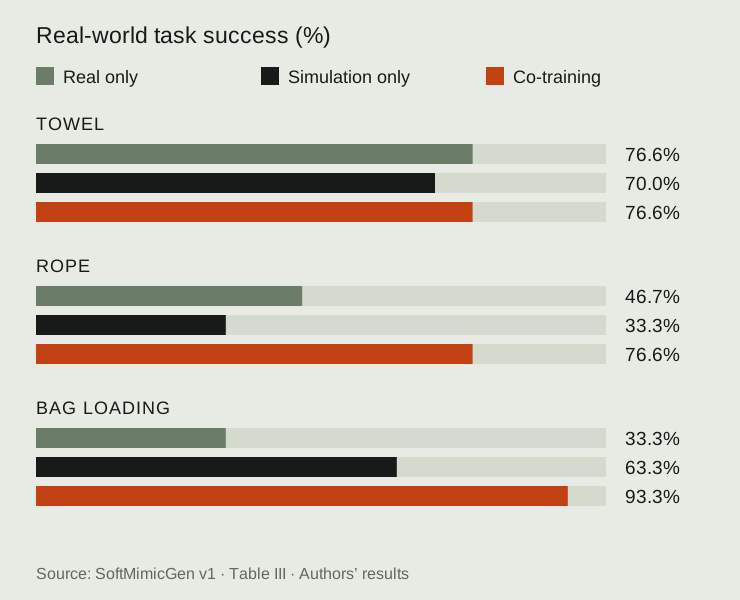
| Task | Real only 30 demos | Simulation only 1,000 demos | Co-training 1,000 sim + 30 real |
|---|---|---|---|
| Franka · Towel | 76.6% | 70.0% | 76.6% |
| Franka · Rope | 46.7% | 33.3% | 76.6% |
| YAM · Bag loading | 33.3% | 63.3% | 93.3% |
Simulation-only policies transfer to real hardware in these tasks. Co-training improves the reported rope and bag-loading results, while the towel result matches real-only training. This supports synthetic data’s usefulness within the evaluated setups. [1]
Task success is different from simulator accuracy
A successful policy can tolerate an imperfect model. An unsuccessful policy can encounter perception, control or timing problems even when important aspects of the physics are modeled well. The percentages above cannot isolate those causes.
They also do not establish how an arbitrary garment, camera, gripper or starting state will behave. Before using a published result to plan your own deployment, write down the claim you actually need to test. “This policy transfers to our setup” and “this simulator predicts our fabric dynamics” lead to different protocols.
SoftMimicGen uses simulator-provided object nodes during data generation and Point Bridge representations for real-world deployment. Those are relevant components to inspect when assessing a proposed adaptation. [1]
What would measure the physics more directly?
A separate cloth benchmark compares real RGB-D observations with MuJoCo, Bullet, Flex and SOFA, examining dynamic movement and quasi-static interaction with a table. Its largest reality gaps occur during dynamic manipulation. This is evidence about those tested systems and configurations in a 2024 study; it does not evaluate present-day Newton/Warp performance. [2]
NVIDIA Warp is a framework for accelerated computing and simulation. It compiles Python kernels for CPU or GPU execution; the chosen solver and model determine the physical assumptions of a particular simulation. Warp itself is not a learned world model. [3]
For a physics comparison, specify the material, geometry, grasp, motion and measurement method. Use recorded fabric motion as the reference, keep calibration separate from evaluation, and report where the model disagrees. Comparing visually attractive renderings is a much weaker test.
Design the experiment around a decision
Suppose your project needs to fold a particular towel. Start by choosing between two experiment goals.
Goal A: evaluate the policy
Freeze the checkpoint and action mapping. Define a set of starting states and a task outcome before running trials. Record original observations, applied commands, resets and operator interventions. Evaluate the pipeline you intend to use, including its sensing and timing.
If performance changes with a new towel, retain that result and investigate. The change alone does not identify whether the cause is material dynamics, appearance, grasping or something else. A second experiment can vary one of these factors more deliberately.
Goal B: evaluate a simulation model
Choose a bounded motion with a well-defined initial condition. Record the real cloth trajectory using a calibrated measurement method, then compare the corresponding simulated trajectory under declared settings. Decide beforehand which discrepancy matters: point position, timing, shape, slip or another task-relevant quantity.
Use some trials to estimate unknown parameters and reserve others for evaluation. Document sensor uncertainty and any alignment or tracking errors. A calibrated model should be judged on observations it did not already fit.
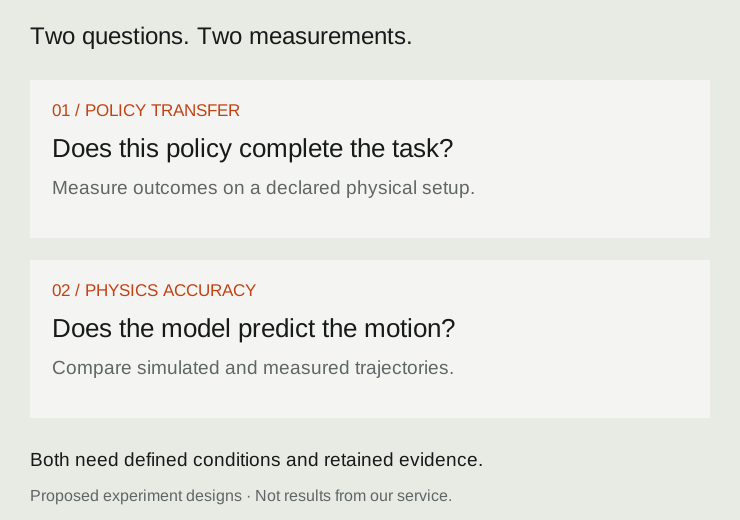
These are proposed experiment patterns, not results from our service. A useful test can be small: one relevant material, one agreed motion and enough repeated observations to inform the next decision.
Primary sources and scope
- Moghani et al., SoftMimicGen (2026), version 1. Method and Section V-E / Table III. Also see the authors’ project page. We have not independently reproduced these results.
- Blanco-Mulero et al., Benchmarking the Sim-to-Real Gap in Cloth Manipulation (2024). A distinct study of four simulators and defined cloth tasks.
- NVIDIA Warp, official repository. Framework scope and execution model.
Reviewed 25 October 2026. The experimental recommendations are Actuator Science’s interpretation. Related: A practical simulation-to-hardware checklist.